
If Part I established that music had moved from the background to the centre of Indian brand storytelling, Part II is about what followed — when sound began delivering not just emotion, but outcomes.
By 2025, music-led campaigns stopped being interesting creative choices and started proving their commercial and cultural weight. The question was no longer does sound matter? It became what happens when it’s done right?
Across categories, brands began using music not to decorate narratives, but to sharpen them and audiences responded.
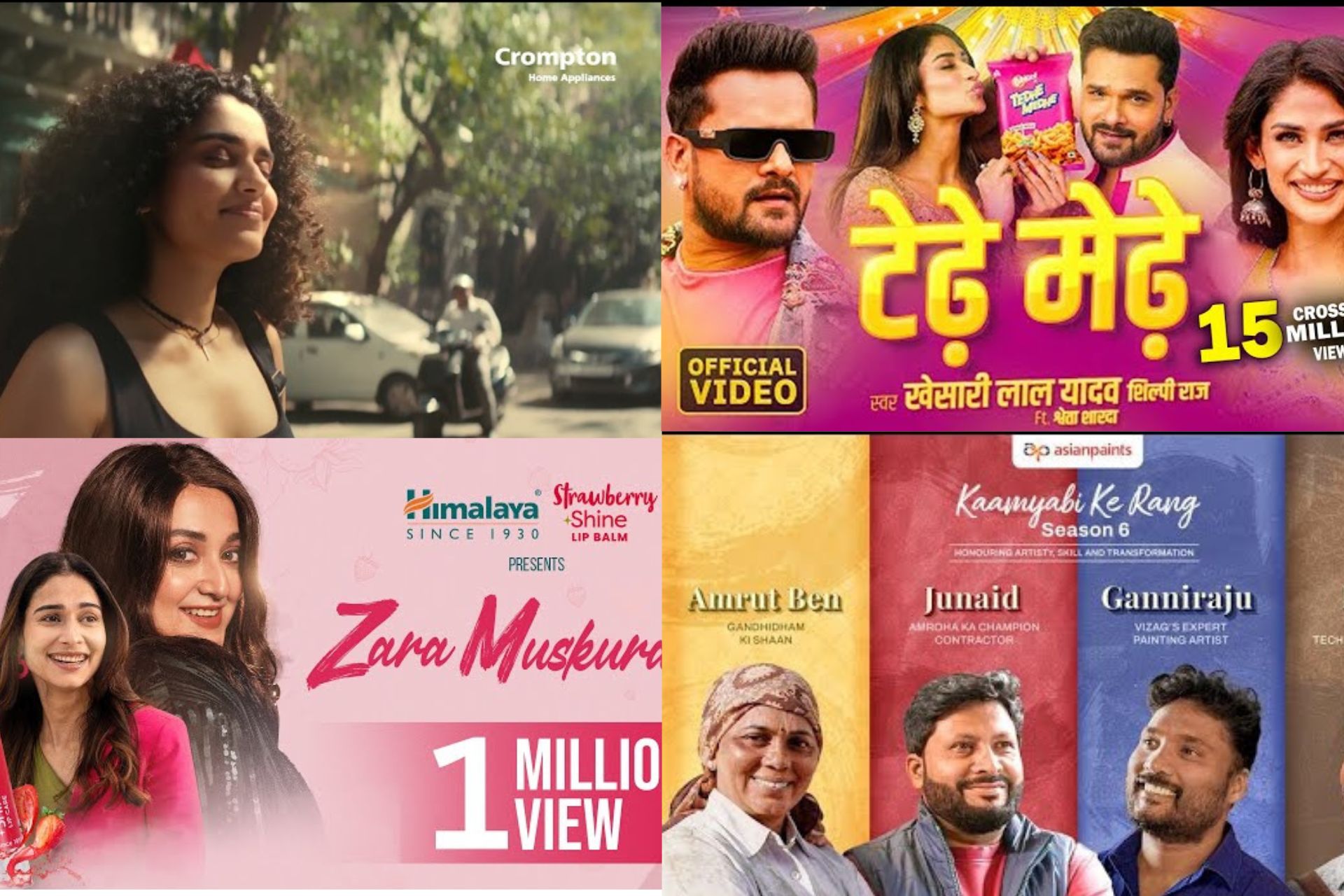
For Crompton Greaves Consumer Electricals, the success of #AankhBandhKarkeLelo lay in what it deliberately chose not to do.
In a category driven by specifications, comparisons, and technical reassurance, Crompton let music shoulder the responsibility of trust. The sonic language was calm, familiar, and emotionally grounded, reinforcing the idea that comfort is recognised instinctively, not analysed.
What the campaign demonstrated was maturity. Instead of over-explaining performance, Crompton allowed sound to settle doubt before logic entered the conversation. The result was communication that felt confident rather than convincing, a subtle but powerful shift in how functional categories can use music to reduce friction in decision-making.
With Bingo Tedhe Medhe, the proof came in scale.
The brand’s Bhojpuri music-led campaign featuring Khesari Lal Yadav, Shilpi Raj, and Shweta Sharda leaned unapologetically into regional sound, without translation, dilution, or explanation.
The outcome validated the approach. The campaign crossed 10 million views, reinforcing a growing insight for brands in 2025: cultural specificity does not limit reach. When music reflects lived culture rather than marketing interpretation, it expands relevance rather than narrowing it.
A different kind of validation arrived for Himalaya Wellness.
Zara Muskurade, created for Himalaya Strawberry Shine Lip Balm, stood apart in a beauty category dominated by aspiration and exaggeration. Fronted by Monali Thakur and featuring Aneri Vajani, the campaign chose softness, emotionally and sonically.
The music didn’t perform. It accompanied. And that restraint translated into recognition beyond metrics. Created with Hoopr Brand Solutions, the campaign won the People’s Choice: Best Ad Film Award at the 15th Dadasaheb Phalke Film Festival in 2025 — affirming that authenticity, when paired with craft, still resonates deeply with audiences.
For Mahindra, music became a way to humanise technology.
Boom Boom, created for the BE 6e and powered by Sunidhi Chauhan, refused to explain electric mobility in rational terms. Instead, it translated performance into sensation. The rhythm carried confidence, momentum, and urgency, allowing audiences to feel innovation rather than understand it.
Sound here did what specifications cannot: it compressed complexity into instinct.
For Asian Paints, music is not a campaign device, it is a long-term storytelling language.
Through Kaamyabi Ke Rang, Asian Paints has built a narrative platform centred on the pride, skill, and identity of painters and contractors. Music functions as emotional continuity across stories, reinforcing dignity, aspiration, and craft without ever overpowering the human voice at the centre.
Rather than anchoring recall to a single tune, the brand uses sound to create coherence over time. Music here is not episodic or seasonal. It is structural — holding together years of storytelling with tonal consistency and emotional credibility.
By the end of these campaigns, a pattern became unmistakable:
- Music entered the process early
- Sound choices reflected brand worldview
- Cultural context was respected, not simplified
- Outcomes showed up as trust, scale, recognition, and recall
As 2025 closes, the strongest campaigns weren’t the loudest ones.
They were the most intentional.
And in a landscape where visuals refresh endlessly and formats expire quickly, it’s sound — carefully chosen, thoughtfully placed — that lasts.

amoxicillin 500 mg capsule
amoxicillin 500 mg capsule
amlodipine besylate 10 mg
amlodipine besylate 10 mg
propecia generic
propecia generic
generic zithromax
generic zithromax
lasix furosemide
lasix furosemide
nitrofurantoin 100mg dosage for uti
nitrofurantoin 100mg dosage for uti